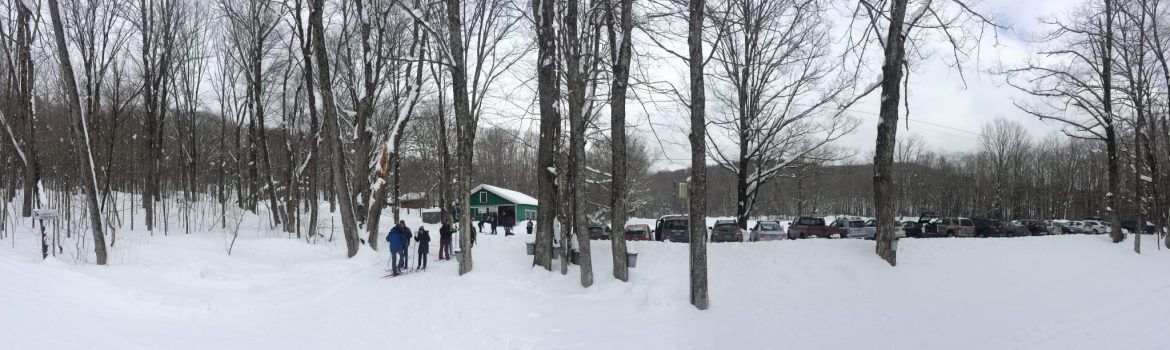


Open at 9 am. The temperature at 6:30 am is 16º. The forecast high is 21º. There is snow falling as I type, with a dusting of new snow on the ground. The snowflakes falling this morning are 10°F.-14°F.: star-shaped plates (stellar plates). If you want more information on snowflakes, keep reading.
25 km open, all the trails. Skiing really does not get any better. The snow is perfect. Low trails groomed again last night. Upper trails groomed the night before. The skiing is so good.
Gary and Dick skied all the trails yesterday. Dick has skied all the trails many, many times. This was Gary’s first 25 km. They both agreed the skiing is great, and the weather is pleasant.
Let’s talk a little about snowflakes. Mary Holland, from Naturally Curious with Mary Holland, had a news letter last week about snowflakes. There are so many different kinds of snow. She shared this poster, it can be purchased here.

Explanation of the poster from their site; “A marvelous collage by Dorothy Wallace-Senft. This poster shows the type of snowflake formation relative to the temperature. Over 400 of Bentley’s snowflake images are cleverly used to illustrate the thermometer. Also contains a picture of Bentley at his camera.”
And from Mary Holland;
“Snowflakes form when water vapor converts directly to a solid around particles in the atmosphere, often around dust or pollen. As these ice crystals grow, they fall. Our recent snowstorm produced exquisitely delicate and complex stellar flakes – much lighter and more intricate than those we are used to. What factors determine the shape of a snowflake?
“It is the temperature at which a crystal forms — and to a lesser extent the humidity of the air — that determines the basic shape of an ice crystal. Contrary to the belief that it can get too cold for snowflakes to form, snowflakes can form at any temperature as long as there is moisture in the air.
“25°F.-32°F.: thin, flat, hexagonal plates
“21°F.-25°F.: needles
“10°F.-14°F.: star-shaped plates (stellar plates)
“3°F.-10°F.: traditional six-branched flakes (dendrites)”
The snow storm last week reminded me of the powder I skied in Montana growing up. Light and fluffy. Bridger Bowl called it “Cold Smoke”. But, somewhere in the middle of last weeks storm the 12 inches of light fluffy snow had a needle snow layer. Look at Mary Holland’s chart, needle snow shows up at the 21ºF to 25ºF. It wasn’t a thick layer, but the temperature in one layer of the atmosphere warmed up and the snow changed. The snow then changed back to traditional six-branched flakes.




1 comment
Loved the info on Snow Flakes! Caught my eye last year with a Hallmark movie involving a “Snowflake Chaser” ….Looking to get a shot of a rare snowflake! The movie included references to the science.
I look forward to obtaining the Snow Flake poster!
Who doesn’t love winter?
Best, diana from Ct